
BRICS members have expressed 'serious concerns' over the unilateral imposition of trade and finance-related measures, including higher tariffs and non-tariff barriers, stating these actions distort trade and are inconsistent with WTO rules. The grouping also highlighted elevated risks to the global economic outlook due to geopolitical tensions, trade fragmentation, and protectionism.

The Supreme Court has raised concerns regarding Bengaluru's Premium Floor Area Ratio (FAR) scheme, questioning its impact on urban infrastructure. The court cited Gurugram's infrastructure collapse during rains as a cautionary tale, contrasting it with Greater Noida's planned development. The scheme allows property owners to purchase additional construction rights, but petitioners argue it strains existing infrastructure and could regularise illegal constructions.

Markets will look for clear guidance on how the MPC interprets the uncertainty and what it implies for the future course of monetary policy, points out Rajeswari Sengupta.

New Reserve Bank of India chief makes his first monetary policy statement on Friday with expectations he may scale back some of the emergency measures that have helped the rupee bounce from a record low.

Tata Sons, the holding company of the Tata group, continues to be classified as an 'upper-layer non-banking financial company' (NBFC) by the Reserve Bank of India (RBI), despite its application to deregister as an NBFC-Core Investment Company (CIC) remaining under consideration. This classification subjects it to enhanced regulation and a mandatory listing requirement, which remains uncertain.

For India, the goal is not simply to host another grand diplomatic gathering. It is to prove that a diverse coalition of emerging powers can still deliver.

The Unified Payments Interface (UPI) has completed a decade since its launch, becoming the backbone of India's digital payments ecosystem. It has seen exponential growth in transaction volume and value, expanding financial inclusion and setting a global benchmark for real-time payments.

India and China are in what experts call 'a cooperation-versus-competition situation'.

'Given the lag in transmission, further softening of lending rates may happen in the coming months.'

Reserve Bank Governor Sanjay Malhotra on Friday said the key policy rates will remain at low levels for a long period and may go down even further.

While the economy will wait for a rate cut in December, the banking industry should be happy with the wave of liberalisation -- a big push for growth in bank credit, points out Tamal Bandyopadhyay.

Sanjay Malhotra has made structural changes to banking regulation to bring down costs and increase efficiency. Plus, he kicked off a benign interest regime. But there are challenges ahead.

India's wholesale price inflation (WPI) increased for the fourth consecutive month in February, reaching 2.13 per cent, primarily due to rising prices of food and manufactured goods, according to government data.

Reserve Bank Governor Sanjay Malhotra on Friday said the central bank does not target any band for the rupee in the forex market, and allows the domestic currency to find its own correct level.

Reserve Bank of India (RBI) Governor Sanjay Malhotra, and Deputy Governors Poonam Gupta, T Rabi Sankar, Swaminathan J, and S C Murmu on Friday addressed issues during the post-policy media interaction.

The University of Chicago has conferred its Alumni Award for Professional Achievement to India's former chief economic adviser Krishnamurthy V Subramanian, the first Indian economist to receive the honour since 1941.

'When there is such an elaborate and a strong process, one would have expected anyone to either place the issues so that they can be addressed or go to the regulator and probably tell them rather than creating a kind of uncertainty for the stakeholders.

The Delhi government's Health Department has received an audit report highlighting alleged financial and administrative irregularities within the Delhi Medical Council (DMC) between 2019 and 2025.

India's wholesale price inflation surged to 3.88 per cent in March, marking the fifth consecutive monthly increase, primarily driven by a sharp rise in crude petroleum, natural gas, and manufactured items amidst the West Asia crisis.

In an event-heavy week ahead, stock markets' movement would highly depend on macroeconomic data announcements, global trends, RBI's interest rate decision and trading activity of foreign investors, analysts said. India's industrial production data for October 2025 will be released on December 1, an official statement said on Friday.

The Reserve Bank of India (RBI) has proposed new measures to combat financial fraud in digital payments, including lagged credit for authorised push payments and a 'kill switch' for users to disable all digital transactions.
The central bank is yet to consider actions such as a rate hike or mobilising dollar inflows from non-resident Indians to boost forex reserves as it cannot afford to continue with them for long when the rupee's internationalisation tops its agenda, explains Tamal Bandyopadhyay.
The RBI's monetary policy committee is expected cut benchmark interest rate by 25 basis points in its policy review meeting next month to push growth, India Ratings and Research (Ind-Ra) said on Thursday. "We expect the headline inflation in FY25 to cool off to 4.7 per cent. Monetary easing may be limited to 75 bps in FY26," Ind-Ra Chief Economist and Head Public Finance, Devendra Kumar Pant said.
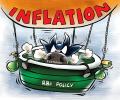
The Reserve Bank on Wednesday lowered the inflation projection for the current fiscal to 4 per cent from 4.2 per cent earlier, taking into account good agricultural output and falling crude prices.
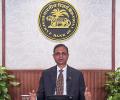
For the time being, the RBI is done with the cuts. A cut in October, which many are still predicting, is not certain. Of course, if growth nosedives, the script will be different, expects Tamal Bandyopadhyay.

Restoring weighted tax deductions and adopting a petty patents regime can foster firm-level innovative activity critical for competitiveness, points out Nagesh Kumar.

Gold prices are likely to remain in a consolidation phase in the near term, but the overall bias will continue to stay positive amid heightened expectations of a US Federal Reserve rate cut in its September policy meeting, analysts said. Traders will closely track US macroeconomic data, such as Q2 GDP, PCE inflation, and speeches from Fed officials, which will provide more insights into the monetary policy stance of the Federal Reserve and the trajectory of the bullion sentiment, they added.

The Reserve Bank of India on Friday proposed to allow banks to lend to Real Estate Investment Trusts (REITs) with certain prudential safeguards to deepen the financing pool for the real estate sector.
Reserve Bank of India (RBI) Governor Sanjay Malhotra said the repo rate cut in the February meeting of the monetary policy committee (MPC) was due to inflation aligning with the target and recognising the fact that monetary policy is forward-looking.
Reserve Bank of India (RBI) Governor Sanjay Malhotra, with Deputy Governors Poonam Gupta, Swaminathan J, T Rabi Sankar, and M Rajeshwar Rao, responded to a range of queries in the post-policy interaction with the media

The Confederation of Indian Industry (CII) has proposed a 20-point policy agenda to the finance ministry, including a conflict-linked emergency credit line guarantee scheme and tax rationalisation on energy inputs, to support MSMEs, exporters, and energy-intensive industries affected by the ongoing West Asia war.

The banking regulator is scheduled to come out with its monetary policy for FY 09 on April 29. "We will wait for the (RBI's) policy statement before taking any decision on our interest rates," ICICI Bank Managing Director & CEO K V Kamath told reporters on the sidelines of an Indian Merchants Chamber-organised press conference in Mumbai on Thursday. Interest rate decisions would also be influenced by prevailing market conditions, Kamath said.

Wholesale price inflation (WPI) fell to (-) 1 .21 per cent in October, driven by a decline in prices of food articles like pulses and vegetables, as well as lower fuel and manufactured items' prices, government data showed on Friday.
Reserve Bank of India Governor Yag Venugopal Reddy presents the First Quarter Review of Annual Statement on Monetary Policy for the Year 2006-07.
The government on Tuesday appointed three external members -- Ram Singh, Saugata Bhattacharya and Nagesh Kumar -- to the RBI's rate-setting Monetary Policy Committee for four years. The central government has reconstituted the Monetary Policy Committee (MPC) of RBI, the finance ministry said in a statement. Ram Singh is the director of the Delhi School of Economics, Saugata Bhattacharya is an economist, and Nagesh Kumar is the director and Chief Executive, Institute for Studies in Industrial Development, New Delhi.
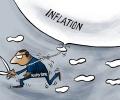
'Deposit and lending rates have started to fall considerably. It is likely to spur investment and consumption of durables.'

'I think today RBI supervision is much sharper than what it was earlier.'
The Reserve Bank of India (RBI) is expected to cut interest rates for the first time in nearly five years in Governor Sanjay Malhotra's first monetary policy committee (MPC) meeting on Wednesday. The meeting of the six-member MPC, which will culminate on Friday, aims to boost sluggish economic growth, which is seen falling to a four-year low. Malhotra took charge as the 26th RBI governor in December last year.
Wholesale price inflation (WPI) declined to (-) 0.13 per cent in June as prices of food articles and fuel saw deflation, along with easing in manufactured product costs, government data showed on Monday. WPI-based inflation was 0.39 per cent in May. It was 3.43 per cent in June last year.

The government on Monday appointed three eminent economists Ashima Goyal, Jayanth R Varma and Shankanka Bhide as members of the rate-setting Monetary Policy Committee of the RBI
